
Conference on customer experience and contact centers in Europe.
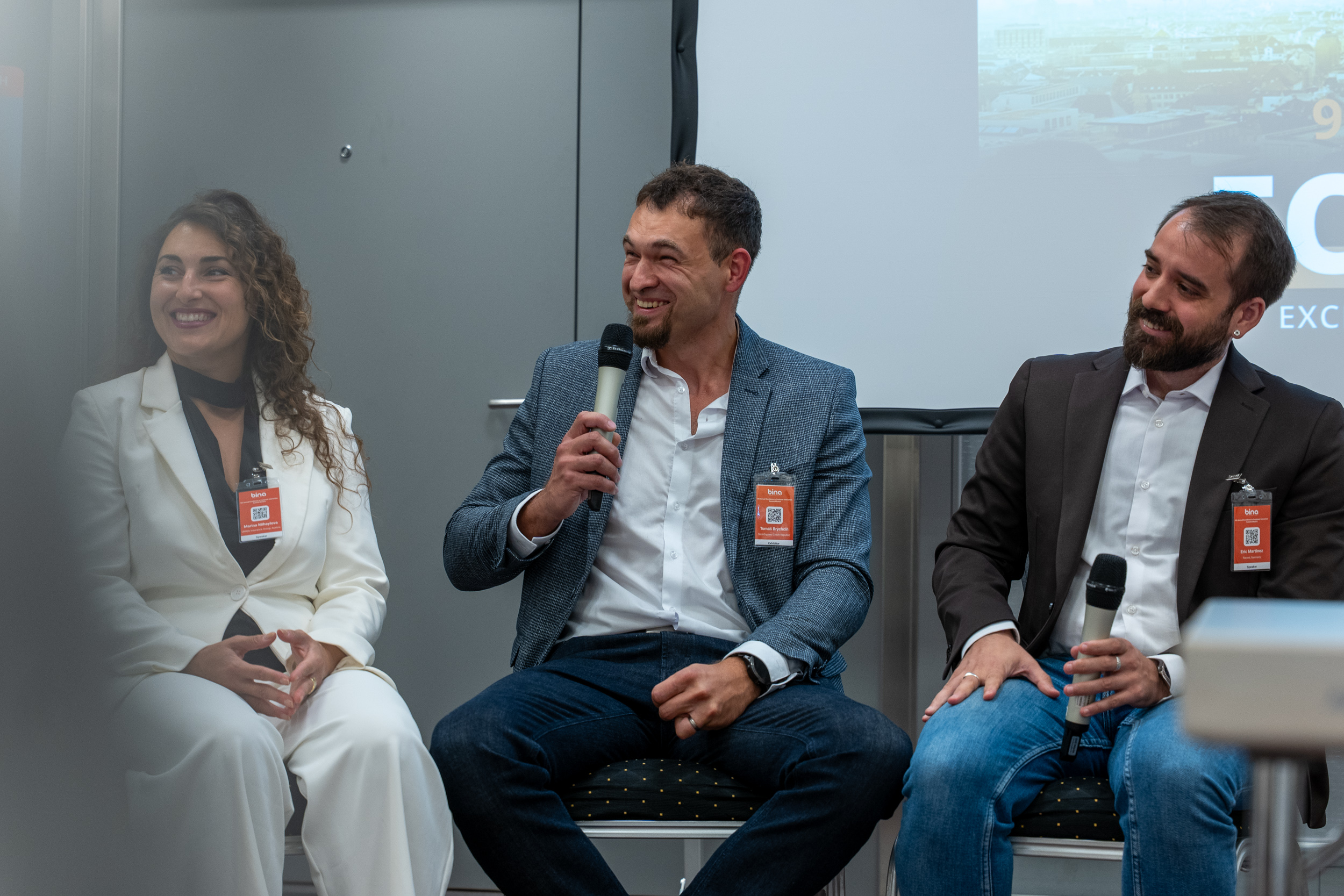
Last week, we attended the ECI Summit Munich, a gathering place for the European CX community—professionals who don’t just theorize about customer experience but manage it in daily operations. Our CEO, Tomáš Brychcín, delivered a presentation, and we also hosted a roundtable discussion where we explored the practical challenges of implementing AI in customer service with fellow attendees.
Here is a summary of the event’s highlights—and why we believe they matter to anyone involved in CX, contact centers, or customer support.

A High-Caliber Professional Event
The thing that struck us about the ECI Summit was the composition of the audience. This wasn't a typical "vendor" event filled with sales pitches and glossy marketing promises. Instead, it brought together true practitioners—CX directors, contact center heads, and customer experience managers from across Europe—professionals with years of experience and an international perspective. Many worked for the same multinational companies but in different countries, offering a unique opportunity to compare customer service approaches across markets from several European countries.
Among the attendees, we met call center managers, CRM experts, product and UX designers, customer-centricity directors, and retail marketing specialists. The diversity of industries combined with a shared theme—how to improve CX—created an environment where specific questions were raised and real solutions sought, rather than just general platitudes.
.jpg)
AI: Yes, but not as panacea
Perhaps the most prominent theme of the conference was a sobering shift away from the initial hype surrounding artificial intelligence. The market is increasingly realizing that Large Language Models (LLMs) do not automatically solve every customer service problem. On the contrary, there is growing interest in combining LLMs with Small Language Models (SLMs). For specific, narrowly defined tasks, SLMs are faster, cheaper, and often more accurate than general-purpose large models.
In other words: instead of relying on "one big brain for everything," it is proving more effective to build smart combinations of tools, where each handles the task it is best suited for. Several speakers presented advanced AI solutions already in active use—yet they were all still actively seeking further inspiration and new approaches. This speaks volumes: the field is evolving so rapidly that even companies with hands-on operational experience do not view their current setup as the final word.
AI wins the production line. Humans win the moments of truth.
One of the most insightful ideas of the entire conference came from Sascha Loux, Head of Growth-Marketing & Sales at AXA: "AI Wins the Production Line. Humans Win the Moments of Truth."
Put simply: the more repetitive a task is, the more it becomes the domain of AI. However, the more critical the moment and the more serious its potential consequences—whether it involves an escalation, an unexpected situation, or a metaphorical "fire" on the contact center line—the more vital the human role becomes.
In our view, this idea perfectly encapsulates the direction in which the entire industry is heading. Automation and AI are taking over routine, repetitive tasks—handling standard inquiries, simple transactions, and standardized processes. Yet, when a situation becomes complex—such as during a sensitive moment in the customer relationship or when a decision with real-world impact is required—it is still the human element that makes the difference.
.jpg)
Valuable insights and experience
Although both the speakers and the audience possessed extensive experience and deep insight into processes, optimization, team leadership, and technology, the discussions clearly showed a shared desire for continuous learning. The conference showcased solutions already being implemented by major players in European markets, and questions from the audience demonstrated a community dedicated to sharing practical know-how rather than just corporate presentations. Moreover, discussions have confirmed that success in this area does not hinge solely on the choice of technology; a well-thought-out AI strategy and the readiness of the data the AI works with are equally crucial.
The Roundtable
In addition to our CEO’s presentation, we hosted a roundtable at the conference titled "Customer Support: From Cost Center to Revenue Driver." Moderated by Peter Kesch, the session explored how customer support can evolve from a mere cost center into a driver of company growth.
The Human Factor: A Key Challenge in AI Implementation
Perhaps the most significant theme running through the conference presentations was how to implement artificial intelligence within organizations without compromising a customer-centric approach or the "human touch."
Team members worry that AI will take their jobs, reduce job security, or alter their roles in ways they do not understand.
For CX leaders this presents few challenging tasks:
1. Involve teams in working with AI, rather than simply mandating it from the top down. People need to understand why AI is being introduced, how it can make their work easier, and what role they will continue to play. Without this engagement, there is a risk of internal resistance that could slow down or completely undermine even a technically sound implementation.
2. Listen to customer feedback and use it to strike the right balance regarding the level of automation. Not every customer wants to—or is willing to—interact with a bot; companies must be able to sensitively assess where AI genuinely improves the customer experience and where it causes harm.
3. Have a clear AI strategy. Deploying AI tools piecemeal and without a broader plan works only to a certain extent; the companies that left the conference with the most concrete results had clearly defined where and why they were deploying AI and how it fit into their overall CX strategy.
4. Ensure data readiness. Even the best AI strategy hinges on the quality and availability of the data the models use. Without clean, interconnected, and well-structured data, even the most ambitious AI initiative remains nothing more than a concept on paper.
And what are our key takeaways?
The ECI Summit in Munich confirmed a trend we also observe in our own practice: the future of CX is not about choosing between humans and AI, but about a smart combination of the two. AI can handle repetitive and predictable tasks faster and more cost-effectively than ever before—a capability further amplified by the combination of large and small language models. Yet, when it comes to the moments that truly define the customer relationship, the human element remains the decisive factor.
It was a fantastic opportunity to compare our own experiences with how CX leaders across Europe approach similar challenges—whether through presentations or roundtable discussions. We also hosted a roundtable of our own.
We look forward to future events and the chance to share new insights again soon.